"Allez les gars, il faut produire quelque chose!"
By Sherley De Deurwaerder, Lex Kleren Switch to German for original article
Listen to this article
How do you narrate economic history in a way that it is not dry, but touching? With the flux-podcast, the Lëtzebuerger Journal has tried to do just that: bringing voices together, making history audible – and drawing a country a little closer.
This article is provided to you free of charge. If you want to support our team and quality journalism, subscribe now.
When I took up my first permanent position at the Journal in January – fresh out of university, a few months of freelancing behind me, more Marxist literary criticism on my mind than basic economic knowledge – I already knew that, sooner or later, a podcast on Luxembourg's economic history would come my way. And yet I felt uneasy when the working group came together for the kick-off meeting and it dawned on me how much responsibility this project would actually entail.
As a teenager, I harboured a secret yet persistent fascination with (aspiring) female journalists in TV series and films – smart, ambitious, occasionally scatterbrained women who often found that idealism didn't function quite as smoothly in reality as it did in their heads. A prototype of this was the overly conscientious, scholastically adept Rory Gilmore, who was not immune to failure.
I had reason to fear, at least in my own estimation, to fear that a similar fate might await me. Although I was interested in history, my way of engaging with the world had so far been less about economics than about abstract analyses of power, language and ideology. Tools that seemed impractical to me at that moment, surrounded by professionally experienced and well-connected journalists.
As the saying goes? All beginnings are difficult. The team had to accept that when we wanted to find out how to bring economic history to life. It quickly became clear that names such as Jean-Claude Juncker, Michel Wurth, Colette Flesch, Guy Castegnaro and Carlo Thelen are indispensable if you want to tell Luxembourg's economic past. Through them, broad lines can be traced: Industry, politics, trade, trade unions and workers. These main interviews were conducted by colleagues who teased out a colourful assortment of youth and tripartite memories from these personalities, as well as insights into economic decisions, continuities and ruptures.
"Only gradually did I realise that the heart of flux lies precisely in this diversity of voices. Not in completeness, but in moments in which history becomes immediate and tangible."
But history also needs historians and researchers who explain, contextualise and contradict. How did the steel industry come into being? What capital stood behind it? Who did it shape – and who did it pass over? Questions that Prof Stefan Krebs, Prof Benoît Majerus, Prof Inna Ganschow and Frédéric Krier, among others, answered with great precision and palpable enthusiasm – and with which they opened doors that we hadn't even thought of before.
And above all, a podcast on economic history needs one thing: people like you and me, who have experienced things, who feel and think, and are happy to share these experiences when asked (and are shockingly often surprised when you do just that). I became particularly aware of this when I was scripting the first season on the steel industry in autumn and kept peeking over our Head of Podcast Maxime Toussaint's shoulder during production to understand what exactly it is that makes a good podcast.
I listened to interviews again and again, some four or five times. So often that I can quote people who – with a few exceptions – I have never met in person. Georges Ginter, for example, whose family worked in the textile trade in Larochette for generations and who cheekily shared that John of Bohemia, set the ball rolling – or the wheel spinning – with a "Allez les gars, il faut produire quelque chose!". Serge Ecker and Thomas Steinmann, who described how volunteers in Dudelange scrubbed old tiles in exchange for beer to make parts of the industrial site usable again. Colette Kutten, who witnessed how a representative of the women's trade union was simply denied the floor on 1 May. Or Jérôme Quiqueret, who turned a brief local news item from 1910 about a murder into an entire book in his search for the "why".
Only gradually did I realise that the heart of flux lies precisely in this diversity of voices. Not in completeness, but in moments in which history becomes immediate and tangible. Today, hardly any other project is as close to my heart as this one. I suspect I needed it to grow into my new role as a journalist, by listening carefully and organising material in pursuit of a narrative thread.
There were afternoons spent on the kitchen floor, surrounded by hastily cut-out pieces of paper with names, time stamps and keywords. Nights when I woke up and wondered what had actually been on this piece of land before the Schmelz in Dudelange. Who owned it. Who had to make way. I rummaged through digitised newspaper articles because I wanted to understand how people like Paul Wurth or Emile Mayrisch were actually perceived in their own time. Not in hindsight, not smoothed over, but in the public discourse of their present.
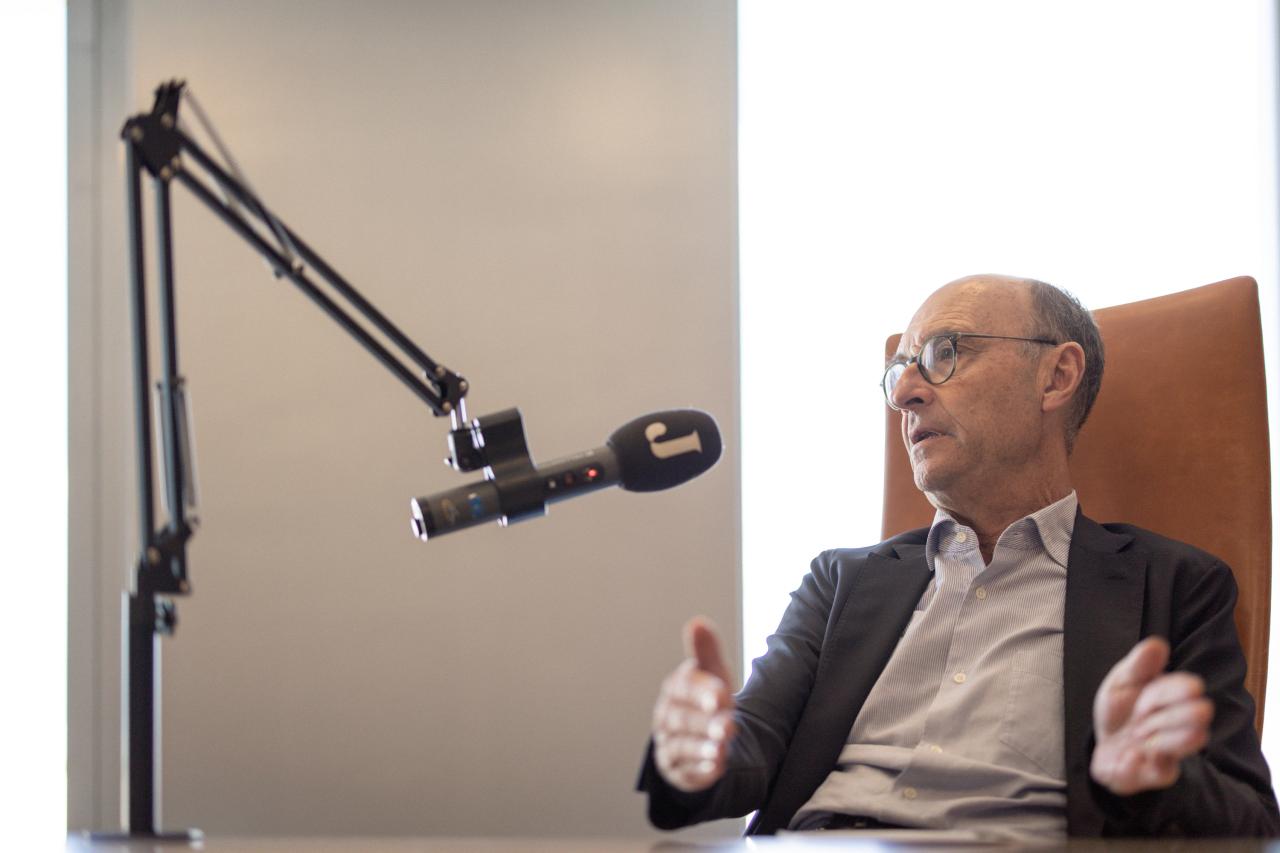
You can't tell everything. Even if the squirrel slumbering within me, after gathering so many bits of information and anecdotes, would have been tempted to add just one more subtle nuance. A format like this demands choice, space, references to the present – and a healthy dose of warmth. Something that I have increasingly learnt in my collaboration with Maxime and that I now allow myself more consciously in my written journalistic work as well.
Because at its core, the task is to shape a larger story out of individual voices – one that you can identify with and that makes you curious about economics. Perhaps flux gripped me so strongly because, in the process, I rediscovered something I had lost during my studies: the small, curious storyteller. She sits next to me again, raises her eyebrow when I get lost in numbers and reminds me that stories must connect before they explain.
In the end, I hope that flux brings listeners closer to this country. That after an episode – or an entire season – you walk through Luxembourg differently, looking and listening more closely. That history is no longer perceived as something closed, but as something that continues to resonate in our streets, our houses and our biographies.