Editorial - Frieden speaks - and says little
By Pascal Steinwachs Switch to German for original article
Listen to this article
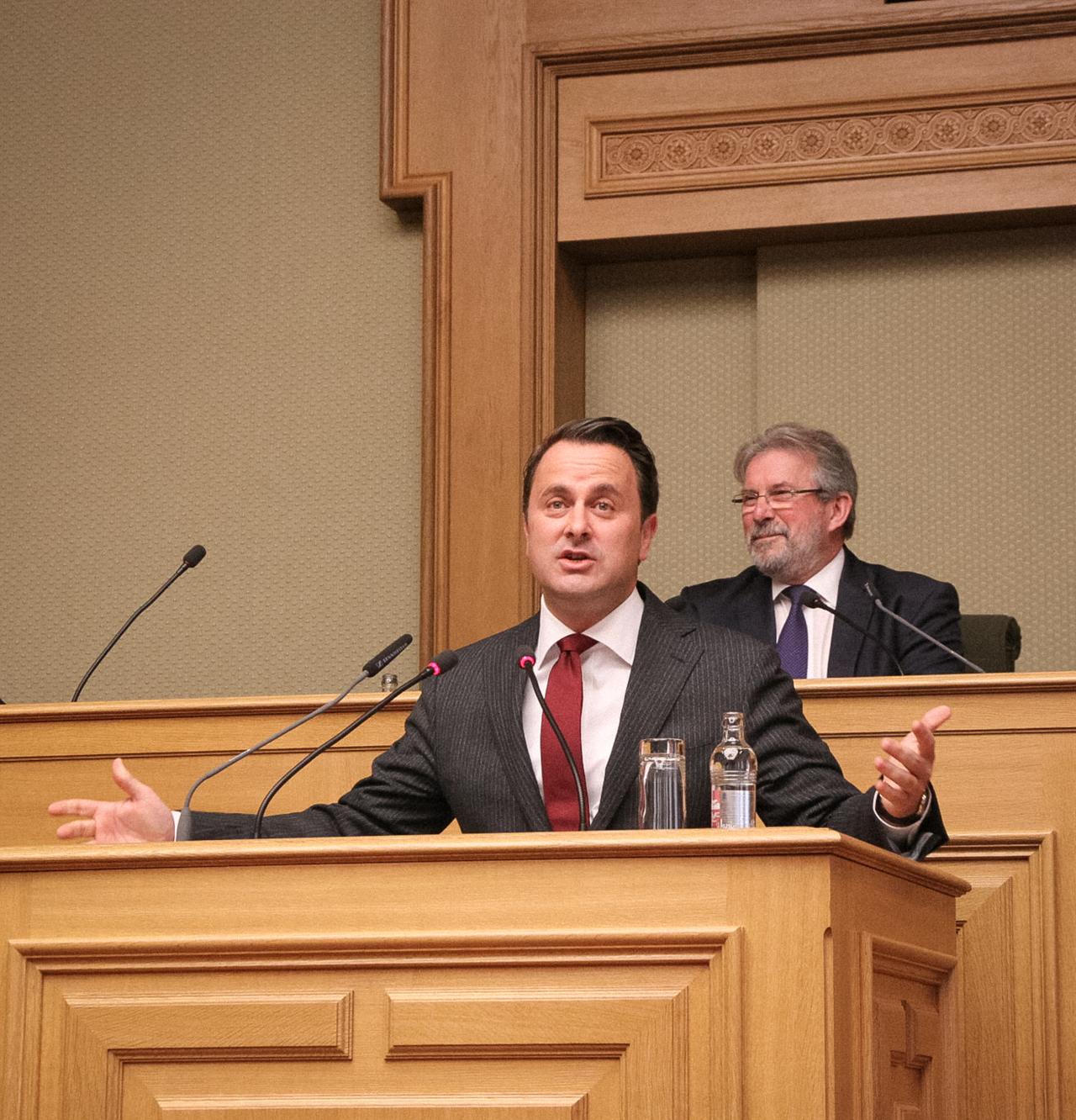
Luc Frieden avoided concrete announcements in his State of the Nation address. Two weeks before the tripartite, the speech seemed less like a political statement of direction and more like an attempt to avoid triggering a debate.
This article is provided to you free of charge. If you want to support our team, subscribe now.
A lot of "Zesummen" ("d'Regierung wëllt Lëtzebuerg erhalen als e Land dat zesummen hält, zesumme steet, zesumme lieft, zesumme wunnt, zesumme wiisst an opwiisst, zesummen d'Natur erhält, zesummen d'Zukunft schaaft", which translates into "the government wants to maintain Luxembourg as a country that sticks together, stands together, lives together, resides together, grows and grows up together, preserves nature together, creates the future together", ed.), little concrete.
This is how you could summarise Luc Frieden's third State of the Nation declaration, this time under the motto "Mateneen. Fireneen." ("Together. For each other."), which the Prime Minister presented in Parliament on Tuesday afternoon in his own sober, class-primus style.
But you could also say: much fuss and even more blah blah blah.
The overkill of "Zesummen" is kind of funny when you consider that things have worked out rather suboptimally in recent years and months, and that the government, and in particular the CSV head of government, have done a lot to sabotage said "together".
"The real acid test for Luc Frieden will come in a fortnight' time at the tripartite. If he fails to deliver here, he shall probably be finished for good."
Luc Frieden, who may appear brisk and decisive, yet in reality never seems to get anywhere, talked once again a lot during the hour and a half of his speech, as I said, but he said very little in concrete terms, particularly with regard to the financing of all the measures listed, all of which were already known one way or another.
The prime minister didn't set any accents, as one would expect from such a statement in these rather turbulent times, but two weeks before the tripartite meeting that would probably not have been a good idea.
In any case, we – and probably most of Luxembourg's political community – are wondering why on earth the head of government insisted on holding his speech so close to the tripartite meeting, instead of holding it after the tripartite meeting, which he himself did not actually want and which he only convened because of pressure from his liberal coalition partner.
However, as he had already held his speech before the tripartite, this time it was really just a waste of time. And if he had really announced something new here, he would have pre-empted the tripartite negotiations, which in turn would have dealt a further blow to the social dialogue, which is already on its knees as it is.
So why this timing?
All of this makes it clear once again that, unlike his two predecessors Jean-Claude Juncker and Xavier Bettel, the CSV Prime Minister is dramatically lacking in political intuition.
It is therefore not surprising that Frieden is clearly the most unpopular prime minister of all time, not even making it into the top ten in the last Politmonitor survey, but only coming in twelfth. The latest Sonndesfro is also downright catastrophic, even disastrous, for the CSV, as the prime minister's party would lose six seats in parliament compared to the 2023 elections and only have 15 MPs: a historic low.
If this continues, Luc Frieden will soon be facing a different wind within the party too, as fears have been circulating in the CSV for some time that Frieden could drag his party even further into the downward spiral.
Externally, most people are still loyal to their prime minister and party leader, but internally the knives are already being sharpened.
One of the few who dares to say something is Michel Wolter, still one of the CSV's grey eminences, who more or less attests to Luc Frieden's lack of political leadership and that he would have been better off not running for party president again. But if Luc Frieden can be accused of one thing, it is that he is resistant to advice.
He didn't make such a huge mistake this year as he did last year with his announcement (which was neither agreed with his party nor with his coalition partner) that he would extend his working life, but probably not even Luc Frieden is that tired of life.
Let us mention at this point that such a declaration (the tradition of giving an annual State of the Nation address was introduced half a century ago by the then DP Prime Minister Gaston Thorn) always follows the same pattern: The (respective) head of government first points out the difficult international situation, then makes a few announcements, most of which are already known, praises himself and his team and appeals to the cohesion of the nation, before the MPs then either praise the statement more or less (the respective prime minister's party more, the coalition partner not quite so much) or tear it apart violently (opposition), depending on their political blood group.
We should also mention that the expectations placed on such a speech in advance, particularly by the political opposition, the social partners and the media, are usually so high that they are almost impossible to fulfil. Only very few people actually listen to the statement in question. Voters are probably only interested in what comes out at the end, to paraphrase Helmut Kohl, and this time that is very little.
The real acid test for the considerably weakened head of government will come in a fortnight' time at the tripartite, anyway. If he fails to deliver here, Luc Frieden shall probably be finished for good.
In a recent radio interview, former LSAP deputy prime minister Dan Kersch has already suggested that he should resign in such a case…