Fruit and vegetables: More self-sufficiency at all costs?
By Christian Block, Lex Kleren Switch to German for original article
Listen to this article
The government wants to push fruit and vegetable cultivation in greenhouses with 20 million euros. It cannot be accused of lacking pragmatism. From the opposition's point of view, however, the greenhouse law missed an opportunity to set a sustainable direction.
With one bite, the freshly picked strawberry disappears into Jean-Claude Muller's mouth. "Wonderfully sweet, " he says. It's mid-May. We are standing in a polytunnel (a structure covered with plastic film) in the countryside around Contern, where the fruit is gradually harvested as soon as it is ripe.
Today, the Muller-Lemmer family business grows rhubarb, mirabelle plums, apples and cherries on around ten hectares. The farm manager cannot (or does not want to) reveal whether he is the largest vegetable farm in the country with his 20 hectares of lettuce, cabbage or pumpkin. "There are a few others hovering around that size."
Strawberries are also one of the fruits that, according to Muller, have a good chance of being grown in glass greenhouses in the future. In mid-May, just five months after the depot, parliament passed the subsidy law for the construction of greenhouses with 54 votes in favour. Déi Lénk and déi gréng abstained from the vote. In concrete terms, the state will be providing up to 20 million euros in one-off funding to – it is hoped – boost fruit and vegetable cultivation in Luxembourg on a large scale. If the total amount were to be utilised, this would correspond to an investment of around 50 million euros. Minister Martine Hansen (CSV) wants to organise an initial call for tenders towards the end of the year, followed by two tenders per year for the remaining budget. "With this law, we want to make progress, " she said in plenary.
"Due to our labour costs, we will never be able to produce tomatoes like the Dutch do, for 1.50 or 2 euros a kilo in the season."
Jean-Claude Muller, Operations Manager Haff Muller-Lemmer
The background to this is the country's longstanding low level of self-sufficiency in fruit and vegetables. For strawberries, onions and tomatoes, it is just one per cent, for cucumbers it is half that and for peppers it tends towards zero.
The way things are done here in the foil tunnel could be a glimpse of how greenhouse cultivation might look later on. The plants are placed in tubs filled with soil (a special substrate) in a kind of rain gutter more than a metre above the ground. Aquaponics is one alternative to this. The seedlings thrive by absorbing nutrients directly from the water. The whole setup could even be linked to a fish farm, as the company Fësch-Haff does.
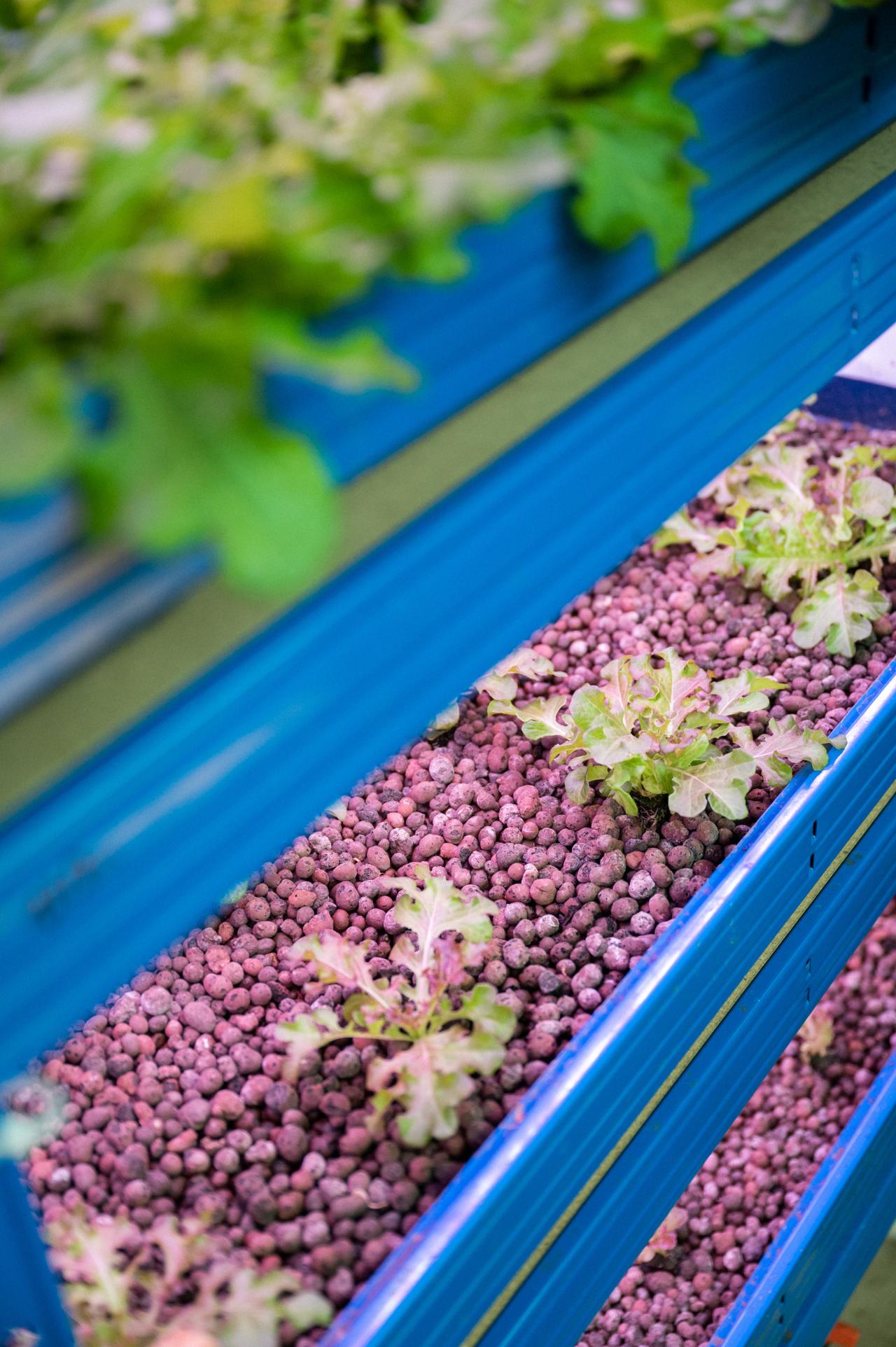


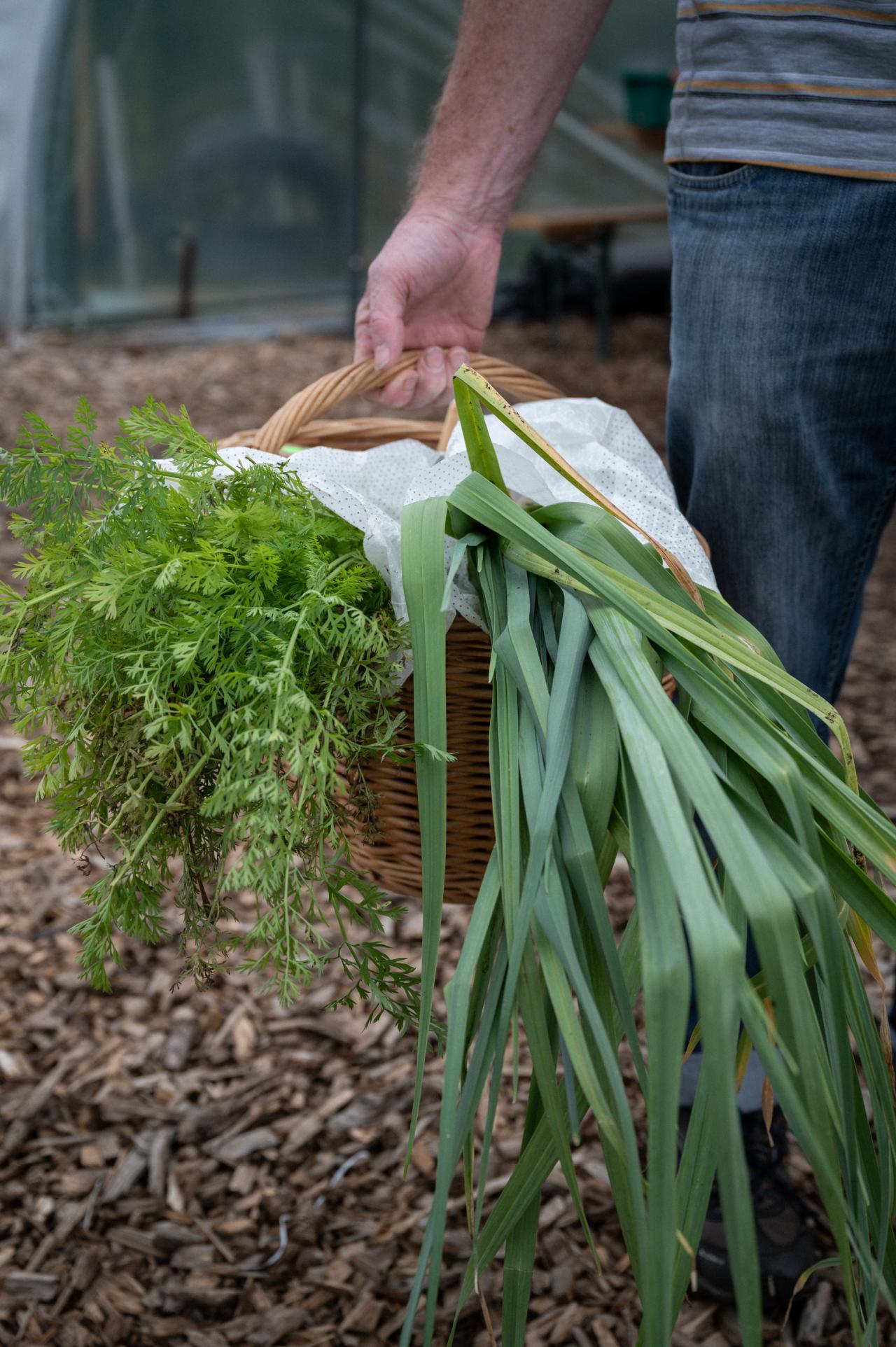
Glass greenhouses offer a number of advantages over open field cultivation. For example, the supply of nutrients and water can be planned precisely. And the latter would make sense right now, after weeks of prolonged drought. On the way to the strawberries, we walked past rows of lettuce heads with sprinklers pouring rain over them. Efficiency is different – even if cultivation in open fields will continue in the future, for example for root vegetables such as carrots. But there are also advantages over foil tunnels. At best, pests don't even get into the greenhouse and ventilation can be better controlled.
Above all, however, plants such as "tomatoes, peppers or cucumbers can be grown in glass greenhouses, which are difficult to grow outside, or in our latitudes are only possible at all with the use of a lot of pesticides […] and all year round". Muller describes the greatest advantage of propagation houses as the ability to heat them.
This increases the yield. An example: If you plant tomatoes outdoors in mid-May, you can expect a harvest in July/August, he says. And then that's it. "The effort is too great for that." In the foil tunnel, ripe fruit can be harvested over a period of four to five months. "And then nine in the greenhouse." The first planting takes place in the third to fifth calendar week of the year, and the same plant is harvested from the end of March until December. The greenhouse is then empty until the next production cycle. "Not only do the temperatures often reach a low point during this time, but the sun is also low." This phase can be used for cleaning work.
"The problem is that the profitability of a greenhouse stands and falls with the procurement of energy."
Jean-Claude Muller, Operations Manager Haff Muller-Lemmer
Greenhouses offer better growing conditions on their own because they store the heat absorbed from the sun even in cold months. There are purely economic reasons why they still need to be heated. "For the overall investment to pay off, you have to produce all the time. That's clear, " emphasises the farmer.
Cost-efficient and sustainable heating?
However, the high energy consumption associated with this is still the crux of the matter. "It's a very big challenge. Unfortunately […] the cheapest way to heat is still natural gas. But we don't want that." Alternatives are the use of biogas or wood as a renewable raw material. "The problem is that the profitability of a greenhouse stands and falls with the procurement of energy." This is because there is hardly anything that can be done about the other major cost items – the investment in the construction and the wages of the employees.
Against this backdrop, it is easier to understand the criticism that Agriculture Minister Hansen faced in parliament last month. As can be read in the final report by Jeff Boonen (CSV), the "Zäregesetz" does provide for the "selection (of projects deemed eligible for funding, ed.) on the basis of sustainability." However, on the one hand, this question will not even arise if only one candidate responds to a call, as Green MEP Joëlle Welfring pointed out in the course of parliamentary work. On the other hand, the law is silent on the sustainability criteria. Only the explanatory notes state that "global sustainability" is to be assessed on the basis of environmental, economic and social criteria, without describing these in detail.


Doubts were therefore raised from the ranks of the opposition as to whether the government was (once again?) going too far with its pragmatic approach, as taxpayers' money would be used to "d'Jalone setzen" (lay the foundations) for many years to come, as David Wagner from déi Lénk put it. Welfring spoke of a "missed opportunity […] to take a creative approach". And reminded the government not least of its promise in the coalition agreement to promote "automated and land-independent technologies for food production […] by establishing special zones near industrial areas", "with a particular focus on the circular economy".
Even if the previous governments can hardly claim to have made major advances in horticulture, the "zones horticoles" that have been discussed since the 1990s but never implemented played a key role in terms of sustainable energy supply. The aim was to utilise CO₂ and waste heat from industry in greenhouses. However, according to Muller, "the sector was not ready at the time". Even if that wasn't the only hurdle. The Journal is aware of one a current project of this kind. The Post Group confirmed to us that it wants to use waste heat from a data centre in a vegetable processing plant. The company did not provide details, but stated that it was looking for a "partner" to realise the project. "It is now up to the interested partners to work out a concrete project that is technically feasible and financially viable."
In the meantime, we are standing with Jean-Claude Muller in the blazing sun at the edge of a field where kohlrabi plants are peeking out of the ground. The practitioner has mixed feelings about the discussion on sustainability criteria. "We're in a water protection area here and the water management authority isn't always amused that I grow vegetables here because there's a risk of leaching (of nitrate, ed.). I then asked them whether they would agree to the construction of a greenhouse here." A greenhouse contributes to the soil sealing problem on the one hand, but prevents problematic leaching on the other. But then rainwater will no longer seep into an area of possibly several hectares, simply because it is needed for irrigation indoors, and will not be available to replenish the groundwater bodies.
"We have not yet subsidised any small glass greenhouses."
The Ministry of Agriculture with a view to the last five years
For Muller, the existing instruments of restrictions and controls such as residue analyses of pesticides are sufficient. He also believes that the potential for coupling with industry is low. "We don't have the large industry here in the country that would provide huge amounts of waste heat."
The chairman of the Landesuebstbauverband sees the government's plan as an opportunity to broaden the agricultural sector. If livestock numbers are to be reduced in order to reduce methane and ammonia emissions, then the sector must also be offered alternatives.
Market shares and the price issue
But Muller also urges caution. Despite the low level of self-sufficiency, the marketing potential of local produce is also limited. "Due to our labour costs, we will never be able to produce tomatoes like the Dutch do, for 1.50 or 2 euros a kilo in the season." In addition, numerous supermarket chains and discounters are firmly established on the Luxembourg market with their own supply chains. And all this with a maximum of one million potential consumers in the country during the day. When it comes to fruit, Muller also points out the high consumption of citrus fruits and bananas in particular, which prevents a high level of self-sufficiency. Even in a country like Germany with more advanced fruit and vegetable production, the self-sufficiency rate for fruit is only 20 per cent. The figure for vegetables is 38 per cent.

Increasing distribution potential is a major concern for the sector. The Restopolis Supply4Future platform opens up "opportunities". And perhaps in a few years' time, the sector will also be positioned in such a way that it can participate more in the school fruit programme. In 2024, the environmental protection organisation Mouvement écologique complained, albeit not for the first time, that "hardly any organic and regional fruit" was still reaching Luxembourg's schools.
But before the first harvest can even be harvested, completely different challenges have to be overcome. One of them: building a greenhouse costs real money. The high investment costs are at the root of the sector's demands for state support. "The investment for greenhouses is beyond the means of current farms, " says Muller. The agricultural law does provide for subsidies for greenhouses. However, the farms in question invest continuously, meaning that the statutory upper limit of two million euros over seven years is always exhausted. When asked by the Journal, the Ministry of Agriculture stated that it had subsidised 26 foil tunnels in the past five years, but no glass greenhouses. The statutory subsidies have been available since 2008.
Jean-Claude Muller himself is planning a one-hectare greenhouse that could be extended. He estimates that this project will cost five to six million euros. He is one of four known potential candidates for the legally introduced investment subsidy. Another is the food wholesaler La Provençale, which is considering such a project together with two farmers, as Georges Eischen told Land.
"With this law, we want to make progress."
Martine Hansen, Minister of Agriculture
However, concerns regarding planning permission and coordination with the environmental authorities are currently also clouding the picture. Jean-Claude Muller does not trust the government's promise to roll stones out of the way for the construction in the green zone until the construction of the first greenhouse has been finalised. He fears that the projects will drag on unnecessarily in dialogue with the "Environnement" agencies.
In any case, Muller remains convinced of the fundamental need to grow more fruit and vegetables himself. But why strive for greater food autonomy when there is free movement of goods in Europe? Jean-Claude Muller still remembers 13 March 2020, a Friday. The day before, the government had decided on a variety of measures to contain Covid-19, which would herald the first lockdown a few days later. "That was madness. We sold I don't know how many hundredweight of potatoes that Friday, " he recalls. It was panic-buying. However, domestic production of potatoes also covers up to 40 per cent of consumption.
And in times like these, which are characterised by geopolitical uncertainties, a certain degree of "civil preparedness", as it is called in defence jargon, probably doesn't hurt. NATO, for example, is also encouraging its members to ensure "resilient supply systems" for food and water. Strawberries for emergencies, so to speak.