Listen to this article
On Wednesday afternoon, the sad news came that Colette Flesch, the grande dame of the DP, had passed away at the age of 88. With her passing, Luxembourg has lost a great personality.
Colette Flesch was a great personality with whom the Lëtzebuerger Journal conducted countless interviews over the years and decades, most recently as part of our podcast flux on the history of Luxembourg's economy, in which the deceased will continue to appear in the coming weeks and months.
The author of these lines will sorely miss Colette Flesch. The entire team of the Lëtzebuerger Journal extends its heartfelt condolences to the family.
Below is an extract from our article on the history of the DP, which was published four years ago.
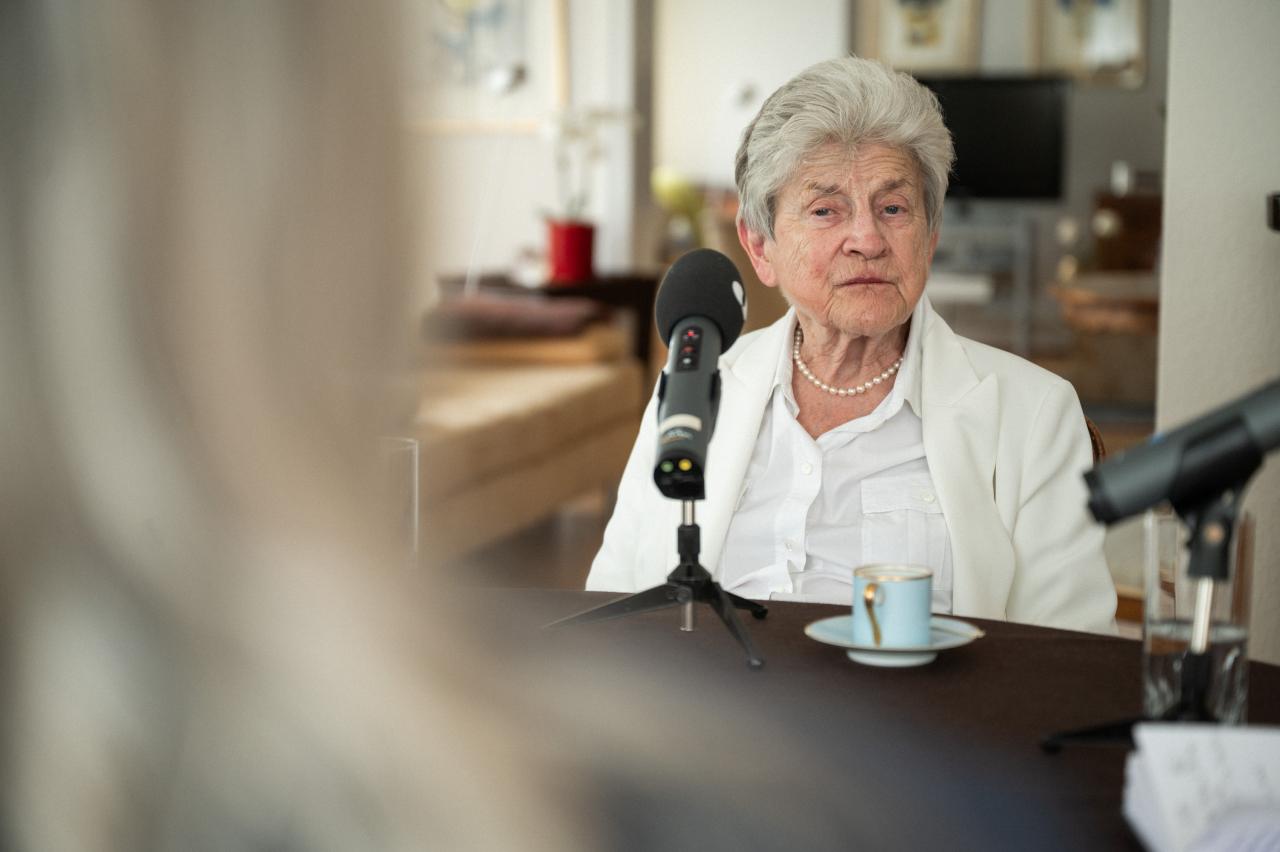
"In her long political career, Colette Flesch has been a member of the Chamber and the European Parliament, mayor of the capital and deputy prime minister as well as party president, and, outside of politics, also a fencer, Sportswoman of the Year and Director General at the EU Commission.
Born in Dudelange, Colette Flesch left the Grand Duchy with her family in 1940 after the German occupation of Luxembourg, only to return to Luxembourg from France in 1945. However, politics had already played a major role in the Flesch family before that, as Colette Flesch's grandfather, Dr Auguste Flesch, was a liberal member of parliament who, among other things, voted for the school law of 1912.
"We were always a liberal family, " Colette Flesch recalls cheerfully. She studied political science in the United States (at the same university as Hillary Clinton, incidentally, and together with the future US Secretary of State Madeleine Albright) and then made a name for herself as a fencer, taking part in the Olympic Games three times (1960, 1964 and 1968). It goes without saying that she was also voted Sportswoman of the Year in 1967.
Her high profile at the time probably contributed to the fact that the then-DP president Gaston Thorn asked her to stand as a candidate for the DP in the early parliamentary elections in 1968. Before the 50th anniversary of the introduction of women's suffrage, she had also been approached by the CSV and the LSAP.
Gaston Thorn called her in the evening in Brussels, where she, who worked for the European Community, had just had dinner with 15 people and asked her if she wanted to run in the elections. She asked for a night to think about it, and when Thorn called her at 7.00 a.m. the next day, she said yes.
As the second substitute candidate after Gaston Thorn and Eugène Schaus, she had initially believed that this opportunity would pass her by, but when the DP took over government responsibility again, she had to decide whether to accept her mandate or not, and this decision was not easy for her. Colette Flesch earned 36.000 francs a month at the European institutions in Brussels at the time, but only 3.500 francs as an MP, and there was no social security either.
"Mir maachen eppes a schwätze kee Blech."
Colette Flesch
"If I had had a family, I would have had to say no, " says Colette Flesch, who then became the second woman to enter the Chamber after the then LSAP MP Astrid Lulling (in 1965). At the suggestion of her party colleagues and due to her experience in Brussels, she also held a seat in the European Parliament, as the European Parliament was still formed by representatives of the national parliaments at that time.
A few months later, Colette Flesch also took part in the local elections and, to her astonishment, received 2.000 more votes than Boy Konen and Camille Polfer. As the DP had promised during the election campaign that the person with the most votes would also become mayor, Thorn told her, "You have to become mayor", to which she asked him if he was crazy, as she had never even been a member of a municipal council and knew nothing about local politics.
However, Colette Flesch remained mayor of the capital for ten years until 1981, when Gaston Thorn became President of the Commission and she moved into government, where she became Deputy Prime Minister and Foreign Minister and also held the portfolios of Economy, Small and Medium-Sized Enterprises, and Justice – unthinkable today.
Flesch's now legendary phrases such as "Industrie crépusculaire" ("sunset industries") and "Den Avenir läit an der Zukunft" ("the future lies in the future") also date from this time. The latter phrase was put into her mouth by a Tageblatt journalist of the time, Mars di Bartolomeo, as she had actually said that "the future [lies] in the industries of the future", which is a huge difference. But perhaps she should have simply said that more should be done for the industries of the future.

As a minister, Colette Flesch has of course experienced a lot. For example, she remembers with a smile a NATO summit in Washington when, at a reception in the White House while everyone was still waiting for Ronald Reagan, she was shouted at by the then French Foreign Minister Claude Cheysson about Luxembourg's satellite plans – much to the displeasure of the German Foreign Minister Hans-Dietrich Genscher, who immediately came to her aid and said to Cheysson, "if you do anything to Colette, you'll have to deal with me".
Colette Flesch also recalls with amusement another anecdote, when she told the US ambassador in Luxembourg, who had asked to see the accounts of a company at the request of his government, that he probably thought Luxembourg was a banana republic. When she was in Washington shortly afterwards, she was greeted there by a secretary of state with the words, "ah, you're the girl from the banana republic".
However, Flesch described the abolition of the death penalty, the liberalisation of abortion, the depenalisation of euthanasia and the reform of civil rights for married women as the most important reforms to which she had contributed. Incidentally, the latter project had already been submitted in 1972 by the then-Minister of Justice, Eugène Schaus, and not, as the LSAP always claims, by the social-liberal coalition of 1974 to 1979.
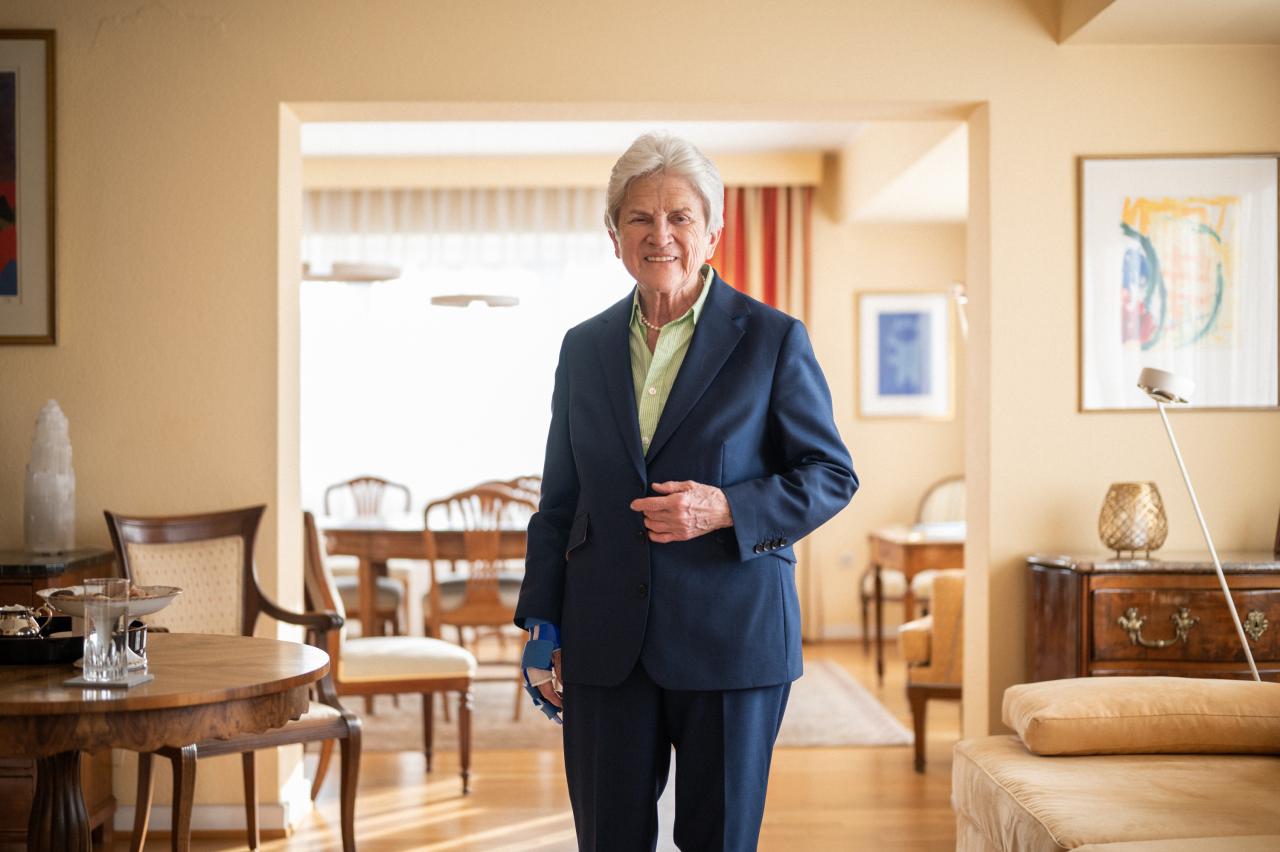


Intellectually, government work is more satisfying than being mayor, says Colette Flesch, but humanly and emotionally, the office of mayor is more satisfying, as you can tackle problems directly and make a difference.
She had learnt from sports to respect the opponent, which also applies to politics. Fair play is particularly important here, as you can't sneak a win, you have to earn it.
However, Colette Flesch is not convinced that language should be gender-inclusive. During our interview, she never once spoke of a female minister, mayor or president, but only of a minister, mayor and president. And the grande dame of the DP doesn't think much of quotas for women either. Instead, it is important to give women a chance and enable them to get involved in politics. That would be more effective than quotas. "Mir maachen eppes a schwätze kee Blech" ("We do something and we don't talk nonsense")…"
R.I.P. Colette…