1cm in ETR – Episode 2: Being your own boss
By Lëtzebuerger Journal Switch to German for original article
Listen to this article
This podcast is called 1cm. That means: one centimetre. Sometimes a small difference changes a lot. For example a parking space.
Hello and welcome to a new part of 1 centimetre.
In the first part, we saw: There are ateliers and the first job market.
In the ateliers, people get more help.
The first job market is for example: a bank, a company, or local services…
Persons with disabilities often do not get enough help.
For example on the first job market.
But what happens when you are your own boss? Is that easier?
In this part, we speak with 2 people.
Michèle is 40 years old.
She created her own marketing company.
Joel is 35 years old.
He created his own app.
Michèle and Joel are self-employed.
That means: they are their own boss.
And they have disabilities.
Michèle
Michèle worked for a lot of years for different companies.
For example for the Fedil.
The Fedil is a group of companies from the country of Luxembourg.
Then she created her own company.
The company is called: WildSolutions.
It is a marketing company on the internet.

Then Michèle found out that she is sick.
She has lupus.
Lupus is a sickness.
The difficult word is: auto-immune sickness.
We will explain this now.
The body has an immune system.
You can also say: defence system.
The defence system protects the body against sicknesses.
For example: when you have a cold or fever.
With an auto-immune sickness:
There is a problem in the defence system.
The defence system then attacks the body.
For example: the knee or elbow joints, kidneys or the skin.
Michèle explains how she feels the lupus.
Michèle says:
Lupus is a sickness that is different for every person.
Michèle is often very tired.
The difficult word for this is: fatigue.
It is a French word.
You say it like this: fa-teeg.
Michèle is not tired in a normal way.
The whole body feels weak.
It is also hard to think.
You feel mentally slow and sometimes confused.
This is called brain fog.
That means: the brain feels like it is in a fog.
Michèle often has pain in her joints.
Michèle learns to live with her sickness
Michèle has learned to ask her body every morning.
What can I do today?
What can I not do?
Do I need to start slowly?
Or can I already do a lot in the morning?
Every day is different.
Michèle explains how she plans her day.
Michèle says:
She has a maximum of 1 or 2 meetings per day.
For Michèle, driving a car is tiring and exhausting.
She has a lot of meetings by video.
This works because she speaks openly about her sickness.
Also with her clients.
They know about her sickness and accept it.
Michèle also hired 2 workers.
That is what she wanted.
Because she can not do everything alone anymore.
That is too much stress.
And stress makes her sickness more bad.
The result (diagnosis) of the sickness came late
Michèle did not know for a long time about her sickness.
She didn’t know what was wrong with her.
At the beginning the doctors said: there is nothing.
Or: maybe you are depressed.
Depressed means: feeling sad and weak for a long time.
Or: drink water, then you will feel better.
Michèle tells us how that was.
Michèle says: the doctors told her she is depressed.
Or that she should not stress herself that much.
Or drink more water.
But these results did not fit.
Because Michèle had a physical sickness.
The doctors took too long to find it out.

After 6 months, Michèle finally got a result.
She has lupus.
It is an auto-immune sickness (Disease).
That means:
If she does not take care, the sickness can get very bad.
This is dangerous for her organs.
And she needs stronger medication.
The paperwork and the costs
Michèle goes to the doctor almost every week.
That costs time.
That costs energy and she gets very tired.
And it also costs money.
Because she has to pay the doctor first,
and she gets the money back later.
Michèle says: the health insurance sometimes sends a paper.
In the paper it says: you will receive no more money from us.
Then she has to go back to the doctor.
The doctor has to write a medical report.
Just to say that she is really sick.
That is a lot of stress.
In English you say: that is a mental load.
That means: it makes a lot of stress in the head.

Joel
Joel is 35 years old.
When he was a child, ADHD was found.
That is an attention disorder.
That means: it is harder to concentrate (to be focused)
As an adult, Joel found out that he has autism.
Joel says: he read a book about a person with autism.
Every page he read, he thinks: that is me.
He waited another 4 to 5 years before going to the doctor.
But for Joel, it was already clear.
What autism and ADHD mean
Joel says how his brain feels.
Joel says: his brain takes in everything.
Every noise, every light, every temperature – everything arrives at the same time.
That costs a lot of strength and energy.
Then he seems annoyed or tired.
But Joel does not mean it in a bad way.
It’s just how his brain works.
Joel's app: AutiHD
Joel made the app AutiHD.
The app helps persons with autism or ADHD in everyday life.
Joel says: the app helps to plan everyday life.
There is a calendar.
There is a chat with artificial intelligence (AI).
The words artificial intelligence means:
A computer that answers like a person.
The app shows how much stress people have.
So Joel can take better care of himself.
And Joel also helps companies to become more inclusive.
Then companies and people with disabilities can work better together.
"Do not give up your dreams."
Michèle
Why an app?
Joel says: for example, there are only few specialists.
When you need a psychologist, you wait for a very long time.
Important, the app is not a specialist.
For example: psychologists.
But the app can help.
And that works good on the phone.
Being self-employed – advantages
Self-employed means: you are your own boss.
As a self-employed person, you can plan your day yourself.
When you feel well, you work more.
When you feel bad, you take it slowly.
Not all persons have this freedom.
Joel says what is the best for him.
Being self-employed – disadvantages
Joel says: it works best when people take him seriously.
When he says he needs silence – then he really needs silence.
As a self-employed person, that is difficult.
Because he is the boss. He can not always say no.
What companies can do
Joel also helps companies.
He says how to work better with persons with disabilities.
Joel says what small changes can do.
Joel says: the most important thing is to understand the persons.
For example:
A person with autism often does not answer "how are you?"
Not because they are impolite or mean.
But they do not understand this question.
When you understand this, it is much easier for the person.
Sometimes the light in the office is too bright.
Or a person wears too much perfume.
Small things can change a lot.

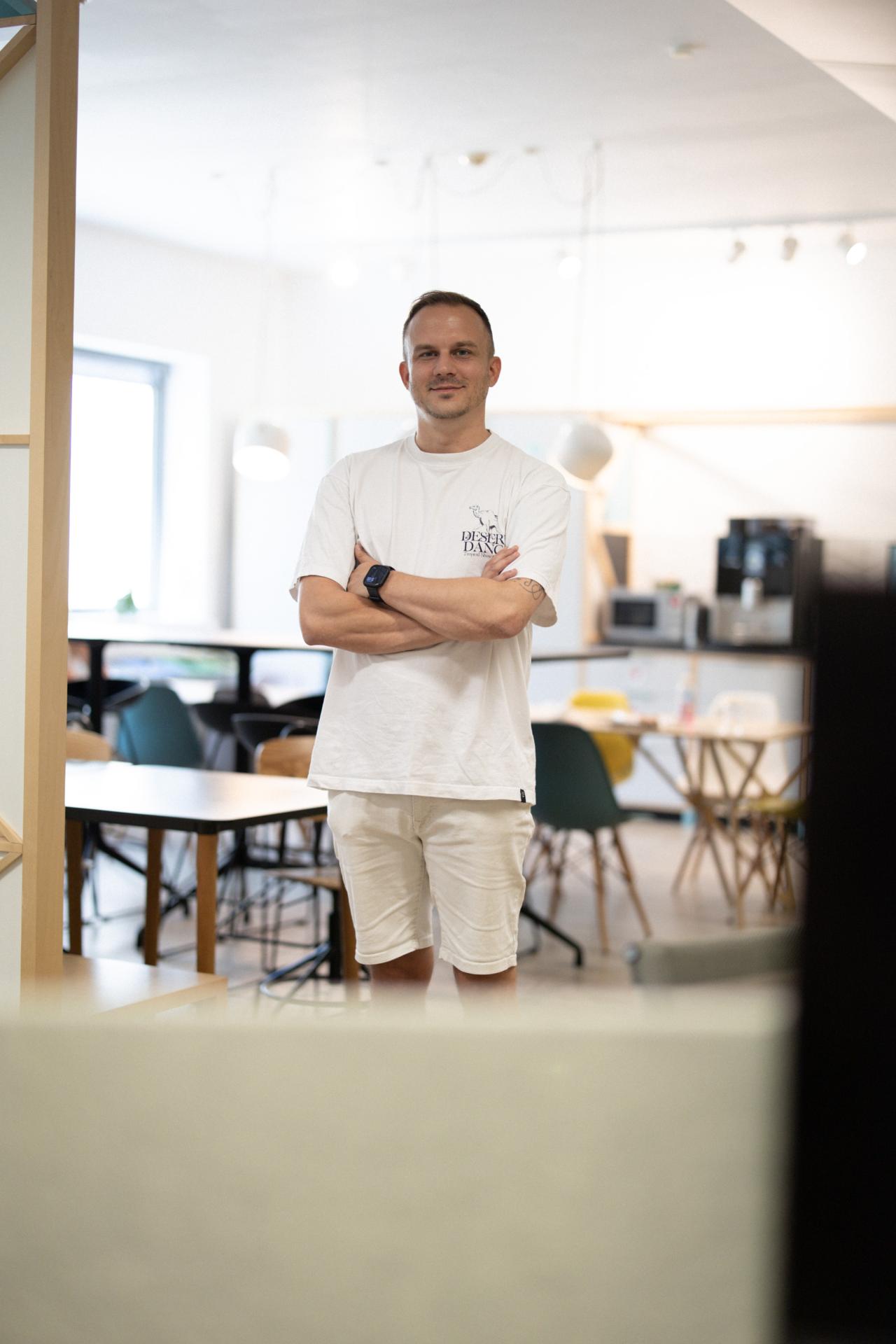
Episod 2: De Joel huet sech mat enger eegener Software-Entreprise onofhängeg gemaach.
Joel also says why different or mixed work groups are better.
Joel says: a mixed work group is the best.
People who think and learn differently.
A person with autism sees every detail for example.
A person without autism often focuses on the main idea.
Persons with different strengths and problems make a good team.
What is the statut de salarié handicapé?
In the country of Luxembourg, there is a status for persons with disabilities.
This is called: statut de salarié handicapé.
It is an official document from the country of Luxembourg.
It confirms that someone has a disability.
With this status, one has different rights at work.
For example: you have 6 extra holiday days per year.
Or the boss makes the workplace easier.
And the boss can ask the country of Luxembourg for financial help.
Many persons do not know that this status exists.
What experts say
Andrea Di Ronco works at Info Handicap.
He says why many persons do not want to show their disabilities.
Andrea Di Ronco says: many persons hide their disabilities for as long as possible.
Often until it is not possible anymore, and then they are doing very badly.
Sometimes they simply do not know about the statut de salarié handicapé.
Christine Zimmer is the boss of Info Handicap.
She says that you should tell your boss about the status.
Christine Zimmer says: you should tell the boss.
Only then the boss can see:
- what can the person do?
- or what can the person not do?
And only then the boss can help.
Also: not every person with disabilities needs the status.
Many persons work on the job market without a status.
That means: the workplace does not need to be easier.
Friendship and help
Michèle and Christine know each other very well.
Christine is Michèle's best friend.
Christine works at Info Handicap.
Christine tells us how that is.
Christine says: knowing a person who has disabilities helps.
It helps to understand.
In everyday life you see: what it means to have disabilities.
Disabilities that you cannot see directly.
But most of all: Michèle is her best friend as a person.
Not because of her disabilities.
And they take care of each other.

Michèle Vallenthini
Tips from Michèle
Michèle gives a tip to other self-employed persons.
Self-employed means: you are your own boss.
Michèle says: she was always healthy and fit.
Because she was full of energy.
She thought: she cannot get sick.
That was a mistake.
Her tip: when you are self-employed, you need security.
That means: register with the health insurance.
The name in French is: Mutualité des employeurs.
This is the health insurance for self-employed persons in the country of Luxembourg.
You must pay the CCSS.
This is the social insurance in the country of Luxembourg.
If you are self-employed you need to decide how much money you keep.
That is the basis.
Because from one second to the next, everything can change.
Bad moments
Michèle tells us that she also had bad moments.
Michèle says: do not give up your dreams.
Yes, there are bad moments.
But it goes on.
She bought herself a badge.
On it is written: "Okay, but did you die?"
No. So keep going.
What have we learned?
Being your own boss can mean more freedom.
You can plan your everyday life yourself.
But it is not always easy.
You have to take care of yourself.
You need people who support you.
And you have to speak honestly about your own difficulties.
You do not need to do a lot to help persons.
Sometimes it is just one centimetre.
Next part
In the next part, we visit people in an inclusion atelier.
That is a workplace for persons with disabilities.
Subscribe to the podcast so you don't miss any part.