Justice in search of efficiency through AI
By Camille Frati, Lex Kleren Switch to French for original article
Listen to this article
Even the justice system is changing, modernising step by step and beginning to embrace artificial intelligence. And the shift is gaining speed.
This article is available to you free of charge. If you want to support our team and quality journalism, subscribe now.
"The government will improve the service to citizens and legal practitioners in relation to justice, in particular by further pushing the use of new digital information and communication technologies." In 2013, the coalition agreement of the first DP-LSAP-déi gréng government outlined the contours of its "Paperless justice" project, presented two years later, which aimed to move justice out of the paper age and "guarantee more efficient and transparent access to justice" by… 2020.
"The judicial administration is among the first administrations to have used AI in an internal application."
Rym Laribi, Delegate for Digitalisation at the Public Prosecutor's Office
Paperless justice – a term that in recent years has provoked nothing but shrugs and smirks from the judiciary. "Every time we have a meeting with the representatives of the judicial administration, they tell us that they are preparing and that things are moving internally, but we don't see it", a lawyer on the Bar Council bitterly reported a few years ago. While the other members of the judicial family – who are not always kind to each other – felt that they had done their homework: lawyers have overhauled their IT architecture and their websites, some law firms are even using artificial intelligence (AI), as detailed in a recent article in the Journal, notaries have adapted to the new rules on electronic signatures and archiving… Even Martine Solovieff, State Attorney General from 2015 to 2025, admitted as much when she left office last February: "The digitalisation of justice, we talk about it a lot and it's progressing very slowly."
In fact, the Covid-19 crisis acted as an accelerator on certain aspects – not necessarily those that the justice system was working on – in spring 2020. From confinement to gradual deconfinement, the judiciary was forced to come up with other ways of operating despite the rules reducing gatherings and travel to a minimum. Electronic communication has finally been authorised for exchanges between lawyers and court clerks, for example to send lawyers' submissions or notify a hearing date.
This full-scale simulation, forced on us by the health crisis, had raised high hopes. "It will have to become the exception for lawyers to travel to a hearing except, of course, to plead their case", François Kremer, President of the Luxembourg Bar Association, was already planning.
For criminal cases, Covid has also accelerated the deployment of videoconferencing. "The courtrooms were quickly equipped and now all releases from the Council chambers are carried out by videoconference, meaning that detainees are not transported for this type of case", says Ms Solovieff. "But of course it continues to be used for substantive cases, because it is still important to be in direct contact with defendants in a courtroom." The same applies to summonses to appear before the examining magistrate, for which the public prosecutor rejects any videoconferencing despite the insistence of the police.

Rym Laribi
In small steps, digitalisation has made its way into the workings of the justice system. Since May 2020, the authenticity of an extract from a criminal record can be checked using a GouvCheck QR code. In the summer of 2022, the Public Prosecutor's Office made it official that 22,000 judicial decisions (currently 36,300) would be available online on the justice.public.lu website, while administrative court decisions had already been accessible since 2001. Since September 2024, all court decisions have been available on the open data platform data.public.lu, enabling legal professionals to download them en masse.
However, five years after the health crisis, the justice system is still not paperless. And this is not an expression of its unwillingness or of the conservatism that is often attributed to it. The justice system has to respect its own specific constraints, discretion and confidentiality must necessarily surround certain procedures, and openness to the public is not a natural reflex for it.
Pseudonymisation, a cursed project right up to AI
Other factors also come into play. A revealing example: the selection of remarkable court decisions that had to be pseudonymised – in other words, each protagonist in the case is given a pseudonym like a letter of the alphabet – before being incorporated into the case law that can be consulted by legal professionals such as judges or lawyers. "The pseudonymisation of judicial decisions was already a subject before 2004," recalls Bob Piron, the Advocate General with responsibility for digitisation. "I found several memos dating from 2004, 2008, 2009 and 2016. Each time, magistrates were asked to select those of their decisions that they considered to decide a question of principle or to be of particular legal interest. The court clerk was then asked to anonymise or pseudonymise these decisions. The system never worked except in certain jurisdictions such as the Superior Court of Justice. I think a lot of people didn't want to highlight their work because they didn't want to appear to be saying that their decisions were more interesting than those of others."
"Justice is often criticised for being slow or too slow. AI can provide tools to save time, the question is how and where."
Bob Piron, Advocate General with responsibility for digitalisation
And in very practical terms, the pseudonymisation work that then fell to the court clerks proved to be tedious: it's not enough to redact each name of a person or company, you have to replace each identifying element with its own pseudonym, for example PERSON 1 or COMPANY 2, without which the decision would be incomprehensible. This was a time-consuming task for human beings, and one that was deemed too sensitive to be automated – until JUANO was born, one of the 13 applications included in the Paperless justice project.
"It's an application designed, developed and managed 100% in-house, " explains Rym Laribi, the public prosecutor's office's digitalisation delegate. "We have taken the artificial intelligence engine used by the French Court of Cassation, based on machine learning, trained it and designed a web interface for users. This makes the judicial administration one of the first administrations to have used AI in an internal application."
Operational since July 2022, the application has benefited from several improvements, with convincing results: by December 2023, 19.3% of the year's decisions had been pseudonymised, a proportion that had risen to 31.5% by the end of 2024. "This year, we are working on a night-time programme that retrieves the decisions handed down during the day and pseudonymises them overnight so that, in the morning, the court clerk sees a dashboard displaying the previous day's decisions to be checked. This will help speed up the process – with a lot fewer clicks. We hope that, in a few months' time, the engine will have learned with a large volume of pseudonymisation, and that we will no longer need human intervention in the process for the simplest decisions. Decisions would then be shared directly on the site." For Ms Laribi, "this is what I've been dreaming of since I've been here: a totally automated pseudonymisation loop".

Bob Piron
Behind this acceleration in the digitalisation of the justice system lies a major strategic change. "The first version of JUCHA (the in-house application used to track a criminal case from the police report to the final judicial decision) dates back to 2007. It has evolved, but it was only fairly recently that we began to think about a digital criminal justice chain with a 100 percent electronic case file, " explains Mr Piron, who knew the first version in green letters on a black screen. "From this came the idea of creating a department dedicated to information and digitisation (attached to the State Prosecutor, editor's note): we realised that the professions needed to become more involved in digitisation."
Ms Laribi agrees: "We had to move away from firefighter mode, where the IT department spends its time putting out fires, to project mode with a more strategic and centralised vision." And the appropriate resources by moving from two people to a head of department assisted by four project managers. Eight new posts have been created this year, with several more to follow. But beyond the number of staff, it's the communication between the IT specialists and the legal staff that has changed. "What struck me during the first meetings I attended with Ms Laribi was that everything was understandable, whereas previously you had two professions that didn't understand each other, " comments Mr Piron.
More of a human challenge than a technical one
Better understanding helps – and so does support for innovation. "Change management takes more effort and investment than the technical project: how to get users on board, how to get them to make better use of the application… not to mention the fact that we had prepared the ground on the standardisation of decisions (so that all judges write names in the same format, for example, ed.) and the use of the internal sharing platform, " explains Ms Laribi. "A dozen court clerks worked on the design of the application: we invited them to test it and give their opinion on the improvements made, we asked them if they had any suggestions… This is our strategy for all projects."
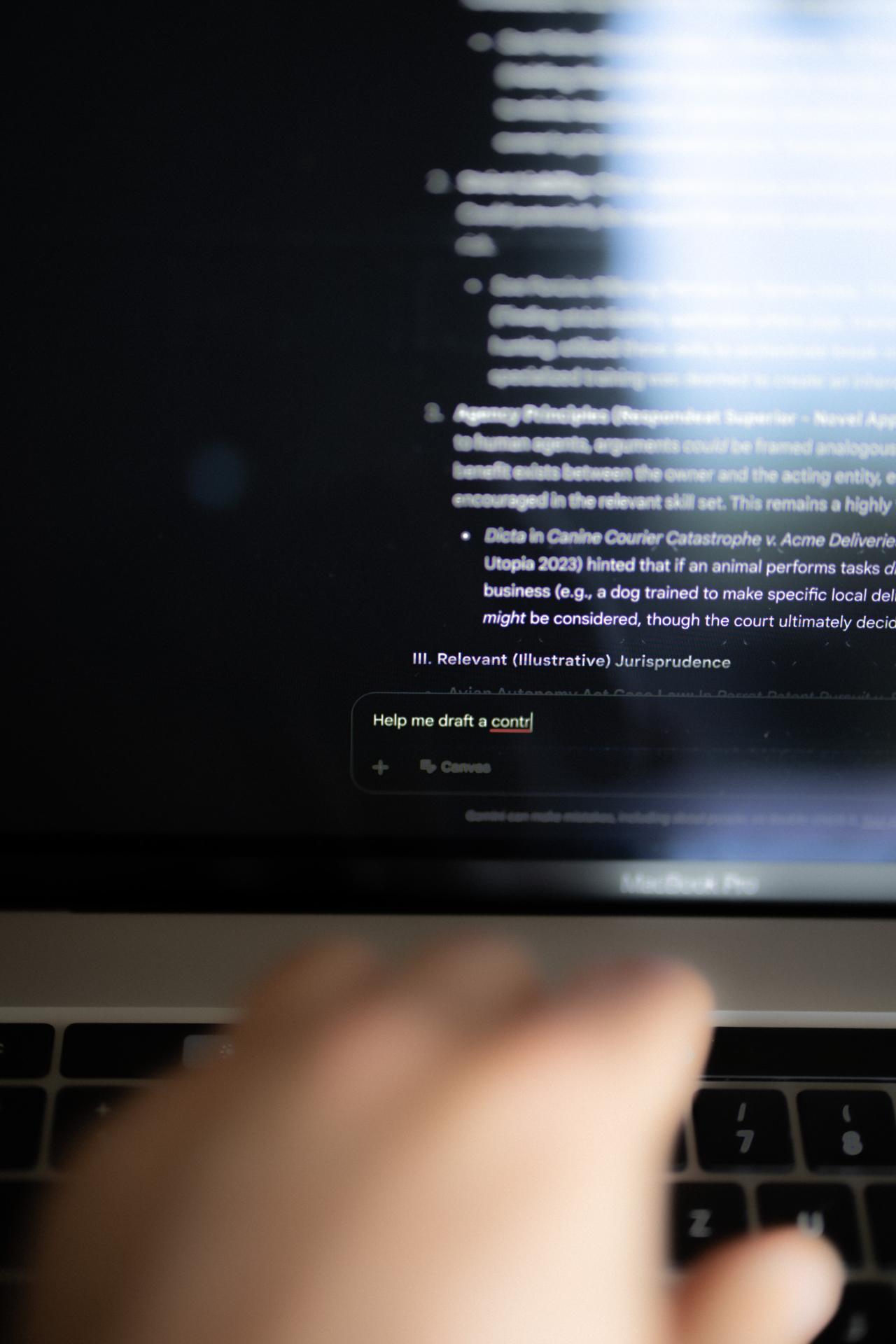
Other projects relying on AI are underway. "We have implemented Copilot as a CTIE-certified in-house help tool, " continues Ms Laribi. "We have communicated internally and explained where it can be used and what to watch out for. For example, if you want to ask it to summarise a decision, you have to use the version without personal data."
The installation of Copilot will be a first step towards another judgement drafting tool, JUAIDE. "This tool will combine several AI components: one for searching case law and suggesting decisions with a similar context, another for summarising a text, and yet another for transcribing, " explains Ms Laribi. "We were inspired by a tool used by the European Commission, we discussed it with the judges and the interested parties formed a working group that identified the functions that were essential and those that were desired The General Prosecutor's Office submitted this project as part of a call for innovative projects from the Ministry of Digitalisation. "We were awarded a budget of 100,000 euros and are now in the proof of concept (POC) phase. The judges who participated in its design have tested it and the results are very interesting. The first version of the JUAIDE POC was released last February."
"Change management takes more effort and investment than the technical project: how do you get users on board, how do you get them to use the application better…"
Rym Laribi
Several training sessions are being organised to introduce AI, its uses and its limitations to magistrates and court clerks. "After that, we're sure to get a few new ideas from users These users were very interested, as the initial session of 70 people was transformed into three sessions of 100 people in response to the large number of registrations.
Ms Laribi's team is also putting forward its own ideas for using AI. "As part of the overhaul of the justice.public.lu website, we want to set up a chatbot (software designed to communicate with users, ed.) to help people find their way around the server internally, and also a chatbot so that litigants can find information on procedures" It's a welcome initiative, given how complex the justice system can seem to those who have never had to deal with it.
The judges are also thinking about other useful applications. "We mentioned AI incidentally at a meeting on the payment order procedure", reports Mr Piron. Payment orders involve forcing a person or company to pay a bill. "We're talking about 75,000 requests to the Justice of the Peace. We are currently considering whether claims could be submitted electronically. But then there's the question of processing: it's easier to examine three sheets of paper at the same time than to display them on a screen… You'd need three screens. Alternatively, we could design an AI that would pre-analyse the documents and compare the tally with the request to say whether or not the request is justified. However, judges are extremely reticent and I myself wouldn't sign any deeds without checking the supporting documents myself."

The same applies to another mass case: road traffic offences such as speeding or drink-driving. Because even if the law sets a fine or penalty for each situation, AI will never replace a judge. "We still have an obligation to individualise the sentence according to the situation of the defendant, and then the judge becomes irreplaceable", stresses Mr Piron.
This is the limit of the digitalisation of justice. "It's still justice, with a lot of procedures that can't be replaced by AI", acknowledges Ms Laribi. "We can't do everything, but AI can still analyse data at a speed that we will never match, " adds Mr Piron. "It's a reality that we shouldn't close our minds to. The justice system is often criticised for being slow or too slow. AI can provide tools to save time, the question is how and where."
The ultimate goal is not to provide fast or expeditious justice, but efficient justice – the leitmotif of all the justice ministers of the last decade. The next major step forward will be the digitalisation of the criminal justice chain – until now managed by JUCHA – with a digital file from the minute the police draw up their report and a paperless process right through to the final judgement. "Initially, we were worried that we wouldn't be ready when the police finalised their digitisation, but now we have a good chance of being ready at the same time, " says Mr Piron with satisfaction. Then there are the cold projects, with no deadline, such as the digitisation of all court decisions dating from before 2007 – they are already anonymised but only exist in paper format. The digitalisation of the justice system has only just begun.